
I'm Doing Everything Right. Why Am I Still Overwhelmed?

Updated: Jun 14

You keep the appointments.
You answer the messages, handle the problems, and take care of the people who depend on you. You probably have the planner, the lists, the reminders, and the routines.
From the outside, you look like someone who has it together.
So why does one extra request, one small, ordinary ask, sometimes make you want to cry, hide, or snap at someone you love?
Why does your mind keep cycling through everything you forgot, everything you still need to do, everyone who might be disappointed?
Why can't you relax when you finally, finally have a free moment?
If you've ever asked yourself, "What is wrong with me? I'm doing everything right" , this post is for you.
Your Overwhelm May Not Be About Your To-Do List
Sometimes overwhelm is straightforward: too many responsibilities, not enough time, help, or support. That's real, and it matters.
But sometimes overwhelm has very little to do with how long your list is.
Two people can face the same kind of day and experience it completely differently. One sees a series of manageable tasks. The other feels an urgent, pressurized rush, a sense that everything is at stake.
The difference isn't motivation or competence. It's what each person's nervous system believes is riding on the outcome.
When a task carries invisible emotional weight, even ordinary days become exhausting:
I cannot make a mistake.
I cannot disappoint anyone.
I have to keep everybody happy.
I should have finished this already.
I must anticipate everything that could go wrong.
I must stay in control.
I cannot let anyone see that I'm struggling.
If I stop, everything may fall apart.
When every item on your list carries that kind of meaning, your day isn't just a series of tasks. It's a continuous high-stakes performance, and no one can sustain that indefinitely without running out of fuel.
Overwhelm Doesn't Always Look Like Falling Apart
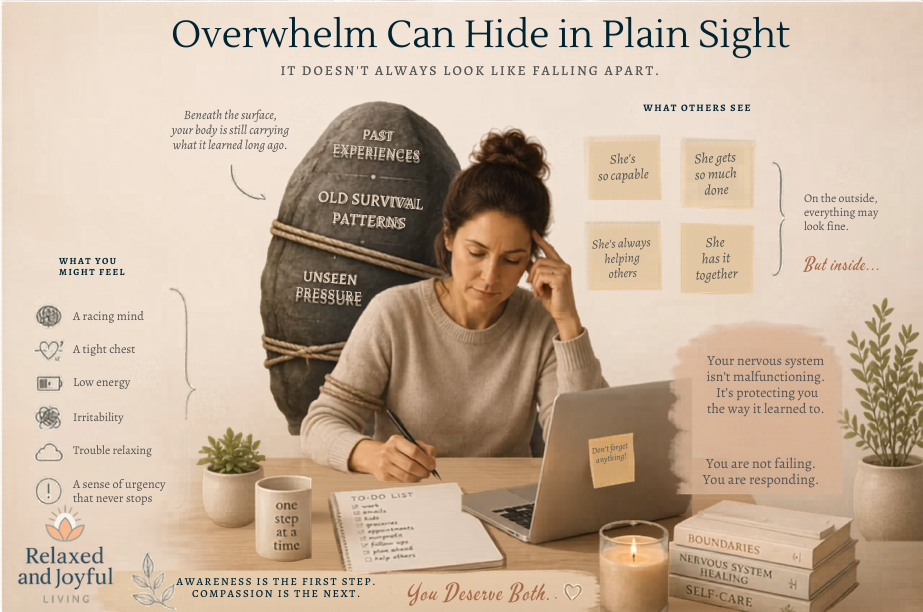
We tend to picture overwhelm as someone visibly unraveling. But many of the most overwhelmed people continue to function. They go to work. They care for their families. They meet deadlines, help others, and show up.
They may even appear calm.
The internal experience, though, tells a very different story.
Overwhelm can look like:
Procrastinating on something that genuinely matters to you
Forgetting things you normally remember
Starting several tasks but not finishing any of them
Feeling irritated by ordinary sounds, questions, or interruptions
Going completely blank when someone asks you to make a simple decision
Scrolling on your phone because you can't face one more demand
Feeling exhausted, but too wound up to settle down
Wanting everyone to just leave you alone
Feeling guilty every time you rest
Replaying conversations and worrying about how you came across
Avoiding a message because you can't figure out how to respond perfectly
Becoming emotional over something that seems small
These responses don't mean you don't care. They often mean you've been caring, anticipating, adjusting, and holding things together for a very long time.
I'm Not Writing This From Above the Experience

I want to be honest about something.
I recognize these patterns because I live them too.
Right now, I am building my own coaching practice while also serving as president of a newly forming nonprofit. Both matter deeply to me, and both involve a seemingly endless stream of decisions, paperwork, planning, communication, financial concerns, and tasks that someone must notice and complete.
At times, the level of overwhelm has become intense.
I can find myself believing that I am the only person who can handle certain responsibilities, or that if I don't keep pushing, important things will simply not happen. It can be especially painful when the practical help, financial support, or shared responsibility I hoped for doesn't materialize. The workload is difficult enough. Carrying it without enough support can make it feel crushing.
So, I am not writing this as someone who has mastered every lesson and never becomes overwhelmed.
I am writing as someone who knows this terrain, uses these tools herself, and continues learning how to care deeply without assuming she must personally carry everything.
There are moments when I have to pause and ask myself the same questions I offer my clients:
What am I afraid will happen if I stop?
Is everything truly mine to carry?
Am I responding to the needs of this moment, or has an older pattern of over-responsibility taken over?
What support do I need, and am I allowing myself to acknowledge that I need it?
Doing this work doesn't mean difficult circumstances stop being difficult. It doesn't make a new organization fund itself, finish the paperwork, or complete the tasks waiting on my desk.
What it can do is help me notice when the real demands of the present have become tangled with an older belief that I must handle everything alone.
I am not standing on a stage telling others how to live from a safe distance. I am in the laboratory too; observing, learning, practicing, and discovering what it means to meet real responsibility without abandoning myself in the process.
Why Rest Doesn't Always Fix It
Rest matters. Sleep, quiet, nourishment, movement, time away from demands, all of it is important.
But rest may not feel restorative when your body doesn't fully believe it's safe to stop.
You can sit on the couch while your mind keeps working. You can take a day off and still mentally rehearse everything waiting for you. You can go on vacation and spend half of it monitoring other people's moods, preventing potential problems, or feeling guilty for not being productive.
Your body may be physically still while your protective system remains on full alert.
This is one reason a new organizational system or self-care routine may bring only temporary relief. Those tools can help manage the outside demands, but they can't address the pressure happening on the inside.
You may not simply need a better way to carry everything. You may need help understanding why your system believes it must carry everything with so much urgency, all the time.
What Your Nervous System May Be Doing

Your nervous system is constantly scanning for signals of safety and danger. It doesn't respond only to emergencies. It can react to conflict, uncertainty, the possibility of disappointing someone, criticism, or the risk of making a mistake.
And past experiences shape what it notices, and how quickly it responds.
Perhaps you learned early to read the room. You became skilled at noticing shifts in tone, expression, or mood. Perhaps being useful, agreeable, quiet, or prepared helped you feel safer. Perhaps mistakes brought consequences that felt far larger than the mistake itself.
Perhaps you carried responsibilities that were too heavy for your age, or navigated circumstances without enough dependable support.
Those patterns weren't flaws. They were intelligent adaptations. Your system learned what it needed to do to help you get through.
The problem isn't that your protective system learned those strategies.
The problem is that it may still be using them, as though the old level of vigilance and urgency is required right now, today, in the middle of an ordinary Tuesday.
The Body Remembers What the Mind Has Learned to Explain Away
Many people describe their past by saying:
"It wasn't that bad."
"Other people had it worse."
"That was a long time ago."
"I understand why they behaved that way."
"I should be over it by now."
The thinking mind can explain, rationalize, forgive, and move forward. But the body continues to respond to patterns it learned through experience, and those responses don't always update just because we understand them intellectually.
Research has associated adverse childhood experiences and prolonged stress responses with effects that reach well beyond emotions. Chronic activation of the body's stress systems may influence sleep, concentration, immune functioning, metabolism, inflammation, and long-term health.
That doesn't mean stress or childhood adversity is the sole cause of illness. Health is shaped by many interacting factors. But it does mean the experiences carried by the nervous system deserve to be taken seriously.
Your overwhelm is not "all in your head."
Your body may genuinely be working very hard to protect you.
The Invisible Rules That Keep You Exhausted
Overwhelm is often intensified by rules we don't realize we're following. See if any of these feel familiar:
I have to finish everything before I can rest.
Other people's needs come before mine.
Saying no makes me selfish.
I should be able to handle this on my own.
Asking for help means I'm failing.
I can't change my mind once I've agreed to something.
I have to explain my boundaries, so everyone understands them.
I must make the right decision before I take action.
If someone is unhappy with me, I've done something wrong.
My value comes from what I accomplish for other people.
These rules can operate so automatically that they feel like facts rather than beliefs. And when they go unexamined, there is no point at which your system receives permission to stop.
There is always one more task. One more person to help. One more possible problem to prevent. One more way you could have done better.
No wonder you're tired.
A Place to Begin
You don't have to overhaul your entire life to start feeling different.
Begin by getting curious about the pressure beneath the pressure.
The next time you feel overwhelmed, try pausing and asking:
What am I afraid will happen if I don't handle this perfectly?
The answer often reveals that the task itself isn't the only source of distress.
Am I responding to what's happening now, or does this feeling seem older or larger than the situation?
Sometimes the intensity of a response is a clue that an old protective pattern has been activated.
What would "good enough" look like here?
For a nervous system organized around preventing mistakes and disappointment, "good enough" can feel surprisingly uncomfortable. That discomfort doesn't mean you're doing something wrong.
You don't have to force yourself into calm. Simply noticing the internal pressure, without judging yourself for it, is a meaningful beginning.
The Goal Isn't to Stop Caring
Reducing overwhelm doesn't mean becoming careless or indifferent. It doesn't mean ignoring your responsibilities or pretending hard things are easy.
The goal is more room for choice.
Because here's what becomes possible when the internal alarm quiets down a little: you can care without carrying everyone. You can be responsible without believing every outcome depends on you. You can make a mistake without turning it into a verdict about your worth. You can rest before everything is finished.
These changes aren't always accomplished through insight or positive thinking alone. You may already understand your patterns intellectually and still find yourself unable to respond differently in the moment.
That doesn't mean you've failed. It may mean the pattern is held at a level that requires more than understanding to shift.
There Is Another Way Forward

In my work at Relaxed & Joyful Living, I use trauma-informed MAP Method™ coaching to help people address emotional and protective patterns, without requiring them to retell every painful detail of the past.
MAP is designed to work with the mind's learned responses and the emotional charge connected to them. The intention is not to erase your memories or dismiss the realities of your life. It is to help your system recognize that an old response may no longer be necessary in the same way.
You may still have responsibilities. Your calendar may still be full. Other people may still need things from you.
But the experience of meeting those demands can begin to feel genuinely different, less like a constant alarm, more like a life you actually have room to live in.
You Are Not Failing at Life
You may have become remarkably good at functioning under pressure. You may be the dependable one, the peacekeeper, the problem-solver, the person who keeps going long after everyone else has stopped.
Those strengths are real.
And you are still allowed to become tired of surviving through strength alone.
Your overwhelm may not be telling you to try harder. It may be asking you to listen differently.
Perhaps the next step isn't learning how to carry more. Perhaps it's helping your mind and body understand that you no longer have to carry everything in the same way.
Curious Whether MAP Might Be Right for You?
A free discovery call is a gentle place to start. We'll talk about what you're experiencing, I'll share more about how MAP Method™ coaching works, and together we can explore whether working together feels like a good fit.
You don't need to prepare your whole story. You don't need to know exactly where your overwhelm began.
You can start with what you already know:
"I'm doing everything I can, and I don't want life to keep feeling this hard."
Resources:
Harvard Center on the Developing Child
2024 multimorbidity study
CDC ACEs overview
MAP Method™ coaching is educational and supportive and is not a replacement for medical care, psychotherapy, diagnosis, or treatment. Please consult a licensed healthcare professional regarding medical or mental health concerns.


Comments