
When Help Feels Hard to Receive

Learning to Be Supported Without Losing Yourself
I woke up recently with a conversation already happening inside my mind.
It was about help.
Not the idea of help. Not the pretty, inspirational version where people gather around, everything becomes easier, and we all magically know what to do next.
I mean real help.
The kind you need when the work is bigger than one person. The kind you need when a vision has grown beyond your own two hands. The kind you need when you know, with absolute clarity, that you cannot and should not carry everything alone.
And still, something inside you reacts.
That is where I am right now, help feels hard.
In my new role as President of Whidbey Island Veterans Guitar Alliance, I can see very clearly that help is needed. This nonprofit has a beautiful mission. It is about connection, music, dignity, Veterans, community, healing, learning, and belonging.
It is also bigger than me.
I can feel how many moving parts there are, and how many people it really takes.
And here is the honest part.
One of the places I can trace this pattern back to is a sentence I heard many times growing up.
My mom used to say, “If I want something done, I need to do it myself.”
I remember hearing that from my earliest memories. It was not just something she said once. It was a message repeated often enough that it became part of the background music in my mind.
And for decades, that message has been running like an old program:
If it matters, do it yourself.
If you need it done right, do it yourself.
If you depend on others, you may be disappointed.
If you ask for help, you may still end up carrying it anyway.
I do not share that to blame her. I imagine she learned that message somewhere too. Many of us inherit survival strategies from the people who raised us, often without anyone realizing it is happening.
But once a message like that gets installed early, it can shape the way we lead, receive, trust, ask, delegate, and organize support.
Thankfully, this is exactly the kind of pattern the MAP process can help address. Not by forcing us to “just get over it,” but by helping the nervous system and subconscious mind update old learning that may no longer fit our current life.
And I thought, if I am experiencing this, others probably are too.
Even when I know help is needed, my nervous system does not always know how to receive it.
Part of me wants help.
Part of me is grateful for help.
Part of me knows people are generous, capable, and kind.
And another part of me can still react as if help is dangerous.
Not because the people offering help are bad. Not because I do not appreciate them. Not because I want to do everything myself.
But because, somewhere along the way, my system learned that help can come with complications.
Sometimes help has not been reliable.
Sometimes help has come with strings attached.
Sometimes help has created more work.
Sometimes help has meant explaining, managing, correcting, organizing, or cleaning up afterward.
Sometimes help has felt like exposure.
Sometimes help has brought judgment, pressure, obligation, or loss of control.
So, the body learns a survival shortcut:
“It is easier if I just do it myself.”

That sentence may sound independent. It may even look capable from the outside.
But underneath it, there may be exhaustion.
There may be fear.
There may be shame.
There may be old disappointment.
There may be a younger part who once needed help and did not receive it safely.
There may be a protective part who decided, “Never again. We will not need people. We will not depend. We will not ask.”
For many of us, asking for help is not a simple communication skill.
It is a nervous-system event.
It can bring up old beliefs like:
“I should already know how to do this.”
“If I ask, I will be judged.”
“If I receive help, I will owe someone.”
“If I let people in, they may take over.”
“If I trust help, I may be disappointed.”
“If I delegate, I will lose control.”
“If I need too much, people will leave.”
And maybe one of the biggest ones:
“If I stop carrying everything, everything will fall apart.”
That belief can become a life pattern.
It can show up in families, businesses, nonprofits, relationships, caregiving, leadership, and even healing work. We may become the strong one, the capable one, the organizer, the helper, the person who keeps everything moving.
And then one day, life asks us to grow into something new.
Not just more strength.
Support.
That is the part I am learning right now.
I am learning that receiving help does not mean handing over my power.
It does not mean opening every door to every person.
It does not mean I have to accept help that does not fit.
It does not mean I have to lose my voice, my discernment, my timing, or my boundaries.
Receiving help safely may actually require more leadership, not less.
It may require saying:
“This is what we need.”
“This is the role.”
“This is the boundary.”
“This is the next step.”
“That kind of help does not fit, but this would.”
“Thank you. I can receive that.”
“I need time to think about it.”
“I appreciate the offer, and I still need to stay aligned with the mission.”
That is a very different kind of receiving.
It is not helpless receiving.
It is not people-pleasing receiving.
It is not overwhelmed receiving.
It is structured receiving.
It is receiving with choice.
It is receiving with dignity.
It is receiving without abandoning yourself.
One image that helps me is imagining a house that has become too large for one person to maintain alone.
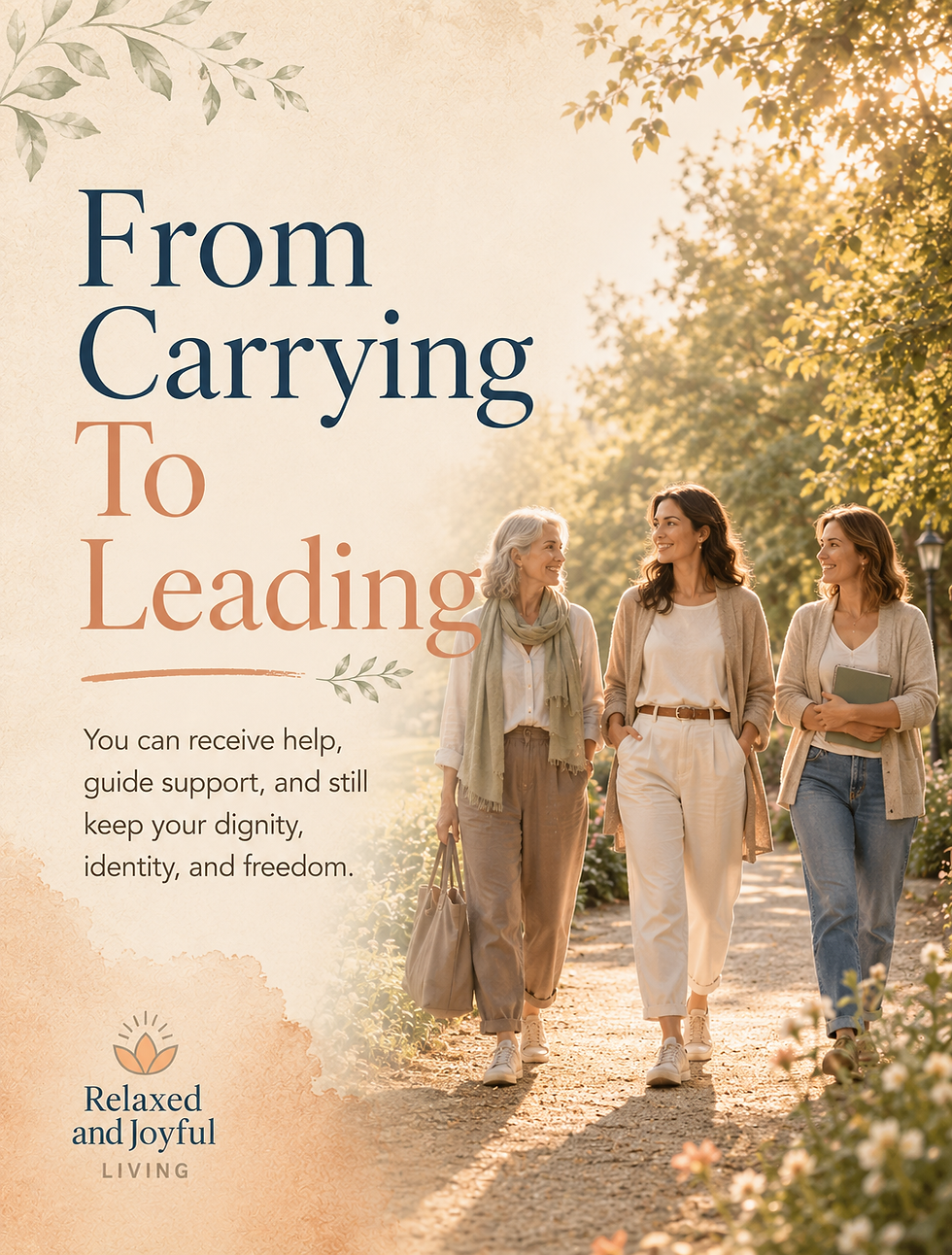
For years, the person inside the house has repaired the roof, answered the door, cleaned the rooms, watched for danger, cooked the meals, managed the schedule, and tried to keep everything from falling apart.
People may have knocked before and said, “Let me help.”
Some may have helped beautifully.
Some may have made a mess.
Some may have criticized the house.
Some may have promised to come back and disappeared.
Some may have walked into rooms they were never invited into.
Some may have meant well but created more work.
Eventually, the person inside the house learns to keep the door closed.
Not because they do not need help.
Because they do not yet know how to let help in safely.
The healing is not to fling every door open.
The healing is to build a porch.
A clear entry point.
A clipboard.
A task list.
A few boundaries.
A way to decide who comes in, where they go, and what they are there to do.
That is what supported leadership can look like.
I do not have to carry the whole house in my body.
I also do not have to let everyone into every room.
I can choose the right help, for the right task, at the right time, with the right boundaries.
This is the place where I believe deep healing work matters.
Because we can know logically that we need help and still feel panic, resistance, shutdown, resentment, guilt, or confusion when help actually appears.
The nervous system may need updating.
The protective parts may need reassurance.
The younger parts may need to learn that today is not then.
The adult self may need support building systems, asking clearly, receiving gradually, and trusting discernment instead of fear.
For me, this is not just a professional topic.
It is lived experience.
It is happening right now as I grow into a role that requires more support than I am used to receiving. It is happening as I learn to lead without over-carrying. It is happening as I notice the places inside me that still want to say, “Never mind, I’ll just do it myself.”
And I am meeting those places with compassion.
Not shame.
Not force.
Not another lecture about delegation.
Compassion.
Because the part that struggles to receive help is usually not trying to sabotage anything. It is trying to protect something.
It may be protecting dignity.
It may be protecting freedom.
It may be protecting safety.
It may be protecting the mission.
It may be protecting the heart from another disappointment.
So instead of asking, “What is wrong with me that I cannot receive help?”
A better question may be:
“What did my system learn about help, and is it still true now?”
And maybe also:
“What kind of help would actually feel safe, clean, clear, and supportive?”
That question changes everything.
Because the goal is not to become someone who accepts all help from all people at all times.
The goal is to become someone who can receive the right help without losing yourself.

Someone who can stay grounded while supported.
Someone who can ask without shame.
Someone who can lead without carrying everything.
Someone who can trust slowly, clearly, and wisely.
Someone who can let support come through the right door.
That is the healing edge for me right now.
And maybe it is for you too.
If your system reacts when you need help, you are not broken.
You may be carrying old learning about what help has meant before.
And old learning can be updated.
One gentle step at a time.


Comments